The Threshold as Liminal Space
The threshold is the most dangerous place in the house. It is neither inside nor outside — it is the boundary between two worlds, and in the ancient imagination, boundaries are where spirits gather. Every culture that has a wedding has a threshold, and nearly every one has a rule about how the bride crosses it.
The tradition of carrying the bride across the threshold is older than the wedding veil, older than the rings, and it survives because the fear it answered was real: the fear that a bride, entering her husband's home for the first time, might trip.
The Roman Fear of the Stumble
In ancient Rome, the moment the bride arrived at her husband's house was the most fraught of the entire wedding. The procession — the deductio — had brought her through the streets, and now she stood at the door of a home she had never entered, about to become its mistress. The threshold was the point of no return.
To stumble here was catastrophic. A trip at the threshold was an omen that the marriage would fail, that the gods had rejected the union, that the household spirits — the lares — did not welcome the bride. The Romans took this so seriously that the bride was lifted and carried across, her feet never touching the stone. She did not walk in. She was brought in.
The groom, or in some accounts the groomsmen, did the carrying. The bride was passive — she did not step, she did not choose, she was conveyed. The act was one of protection, but it was also one of possession: she entered his home, not hers, and she entered it on his terms.
The Spirits in the Doorway
In Northern Europe, the same gesture answered a different fear. The threshold was believed to be inhabited by the spirits of the household and the land — the same spirits that the veil was meant to protect against. A bride who stepped on the threshold risked offending them, disturbing them, inviting their curse on the marriage before it had begun.
Carrying her across was the solution. Her feet did not touch the boundary. The spirits were not provoked. And the groom, by lifting her, demonstrated that he was strong enough to protect her — that the household she was entering was one she could rely on.
There was also a quieter, kinder reading. A bride who was carried could not be accused of reluctance. She could not be said to drag her feet, to enter the marriage unwillingly. The carrying was proof of consent made visible — she was not walking away, and she was not being dragged. She was being welcomed.
The Word Itself
The word "threshold" is an agricultural word. It comes from the Old English þerscold — the board or sill at the door that held the threshed grain inside the house, keeping the winnowed corn from spilling out. The threshold was the piece of timber that separated the clean, kept interior from the muddy, working exterior. It was the line between what was yours and what was the world's.
To carry a bride over the thresh-hold was to carry her over the very boundary that defined the household — from the world of work and weather into the world of hearth and home. It was a crossing in the truest sense.
The Threshold Today
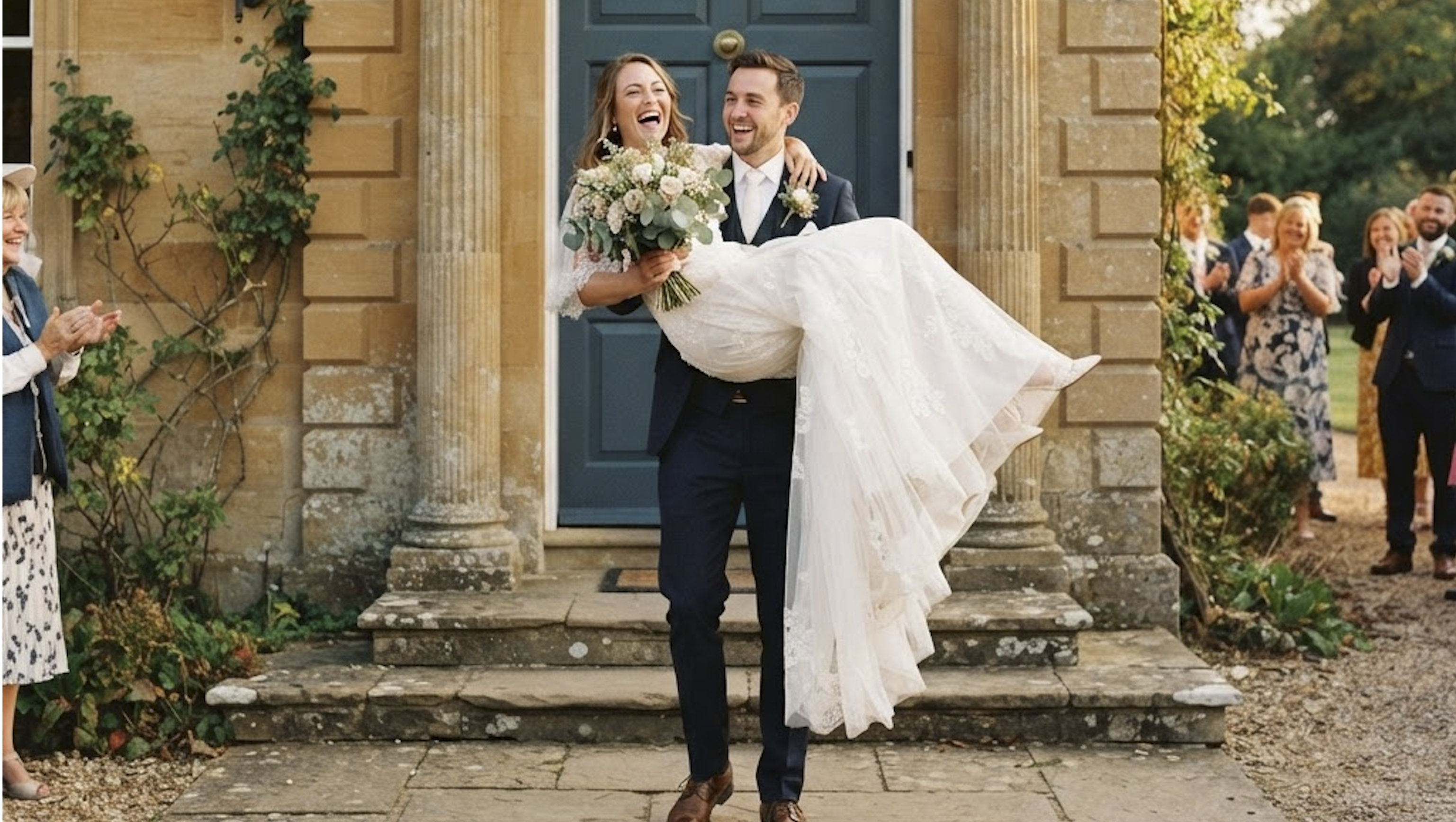
Few couples today know the Roman omen or the medieval spirits. But the gesture persists — the groom sweeping the bride off her feet at the door of the reception, the honeymoon suite, or the first home. It has become a moment of play, of romance, of the first act of the marriage performed in private rather than in front of the guests.
And it is one of the last moments of the wedding day that is genuinely unscripted. The first kiss is rehearsed, the handfasting is planned, the cake is cut on cue. But the threshold carry — that happens at the end of the night, when the formality is gone and the couple is alone, and it is the first small act of the life that follows the wedding.