A Year and a Day
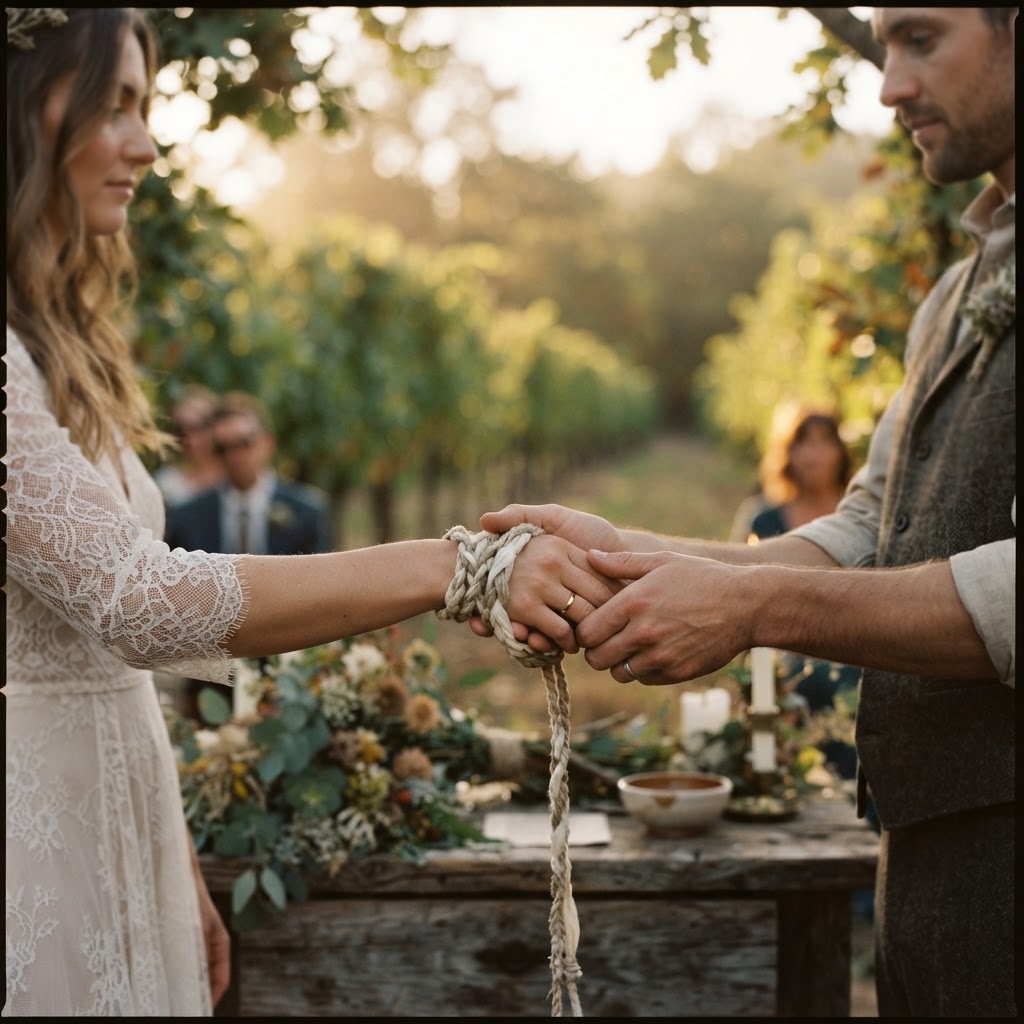
In the Celtic world, marriage was not always permanent — at least not at first. Handfasting was a betrothal and a trial marriage in one. The couple's hands were bound together with a cord of woven cloth or leather, and the union was considered binding for "a year and a day." At the end of that year, the couple could formalise the marriage or walk away, no hard feelings, no fault. It was a practical arrangement for an agricultural society — a year was long enough to see if the union worked, to see a harvest cycle through, to know if a child was coming.
The binding of the hands was the contract. The cord was the signature. And the phrase that came from it — tying the knot — outlived the ritual itself by a thousand years.
The Cord and the Colours
The cord used in handfasting was often braided from three strands — one for the bride, one for the groom, and one for the union between them. The three-strand braid is still the most common form of handfasting cord today. Some couples added ribbons in colours with meaning — red for passion, blue for fidelity, green for fertility, white for peace.
The ritual was common across the Celtic fringes of Britain — Scotland, Ireland, Wales, Cornwall — and survived in pockets long after the arrival of Christianity. In Scotland, handfasting was recognised as a form of marriage well into the early modern period, and the Scottish tradition of the wedding cord is one of the few that crossed intact into modern ceremonies.
The Knot We Still Tie
Today handfasting has been reborn as a ceremony ritual — a moment within the wedding where the couple's hands are bound with a braided cord, often by the celebrant or by family members, while vows are spoken. It is one of the few ancient rituals that couples choose to include not out of obligation but because it is beautiful and because it means something. The cord is often kept as a keepsake, a physical reminder of the moment the promise was made.
And every time someone says a couple is tying the knot, they are reaching back a thousand years to a Celtic cord and a year and a day — whether they know it or not.