A Creature in the Seams
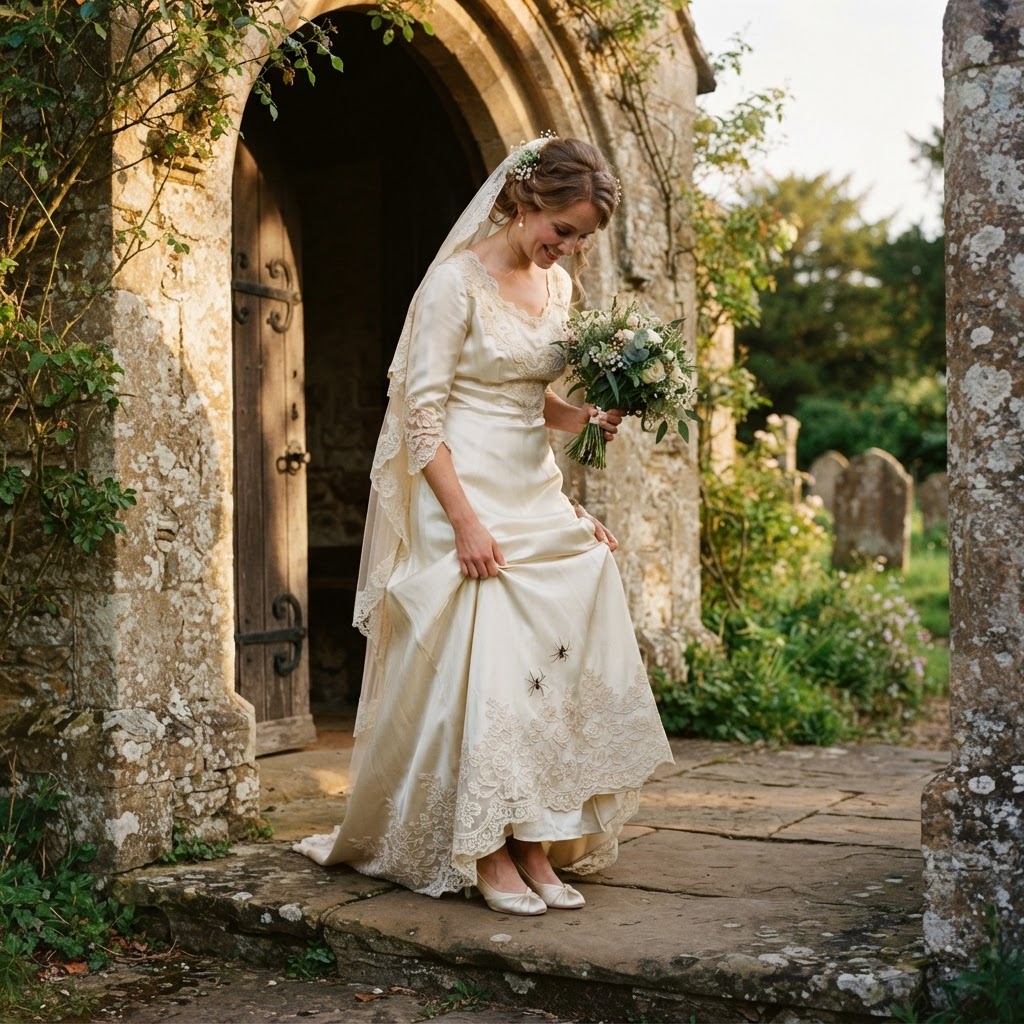
Of all the strange little superstitions that once clung to the English bride, few are as delightfully unsettling as this one: if a spider was found crawling on the wedding gown — or better still, discovered tucked somewhere in its folds on the morning of the wedding — it was considered a blessing, not a nuisance. Brides in parts of England were told not to shriek and brush it away, but to let it be, or even to carry it gently outside, as a sign that good fortune, prosperity, and long life had arrived with it.
It sounds almost like a joke today, something a nervous mother-in-law might say to calm a bride who's just found an eight-legged guest in her silk. But the belief has deep roots, and it says a great deal about how differently our ancestors read the natural world — and how much weight they placed on the wedding dress itself as a kind of charm.
Why a Spider, of All Things
In English folklore, spiders carried a reputation far removed from the fear most of us feel today. "If you want to live and thrive, let a spider run alive" was a common country rhyme, and it wasn't only about weddings — spiders were widely seen as creatures of fortune, associated with industriousness, patience, and the quiet, steady work of building something that lasts. A web, after all, is a thing constructed with extraordinary care, strand by strand, and not torn down without reason.
There's also a quieter, more practical thread running underneath the myth. Spiders were associated with money in English folk belief — a tiny money-spider found on your clothing was thought to foretell new wealth. Transplant that onto a wedding gown, the single most expensive and symbolically loaded garment a woman might ever wear, and the omen takes on an obvious shape: a spider on the dress meant abundance was coming to the new household.
Some regional variations held that the spider had to be found specifically in the lace or the hem — the parts of the gown closest to the ground, closest to the home the bride was about to step into. Finding it there, rather than higher on the bodice, was said to be the strongest sign of all.
The Dress as a Vessel of Omens
To understand the wedding spider, it helps to understand just how superstition-laden the wedding dress became in English tradition generally. This was an era, particularly moving into the Victorian period, when a bride's gown wasn't simply fabric and thread — it was treated almost as a living thing, capable of absorbing or transmitting luck. Brides were warned against trying on the complete outfit before the day itself, lest they "try on" bad luck along with it. They were told to leave one stitch unfinished until the morning of the wedding, so the dress couldn't be "finished" — and by extension, the marriage couldn't be "finished" — before its time.
Against that backdrop, a spider appearing uninvited in the gown wasn't an anomaly to be swatted away. It was simply one more message arriving through the dress, the way a dropped ring or a torn veil might be read as a dark one. The English countryside was thick with this kind of symbolic weather-reading, where insects, birds, and even the direction of smoke from a chimney could all be interpreted as blessings or warnings on a wedding morning.
From Dread to Delight
What's striking is how thoroughly the spider's reputation flipped depending on context. In most other circumstances, especially for Victorian women laced into layers of silk and petticoats, a spider crawling across the body would have provoked exactly the reaction you'd expect. But framed as a wedding omen, the same creature became something to be welcomed, even protected — a rare case of superstition overriding instinct entirely.
The belief has faded from common practice, the way most of these small domestic charms eventually do, nudged aside by changing fashions and a more sceptical age. But fragments of it linger in pockets of English folklore collections, in old wedding diaries, and in the broader cultural memory of Britain as a place where good fortune was something you coaxed quietly into the seams of your clothing, rather than something you simply hoped for.
An Omen Worth Remembering
There's something rather lovely, I think, in a tradition that asks a bride to show grace even toward the uninvited — to look at something small and unexpected and choose to see it as a gift rather than a disruption. It's not so far removed, in spirit, from the other charms we still carry today: the borrowed handkerchief, the inherited brooch, the something blue stitched quietly where no one will see it. The wedding spider is simply one more thread in that old, instinctive human habit of turning small coincidences into good omens — of deciding, on the one day that matters most, that the universe is on your side.