
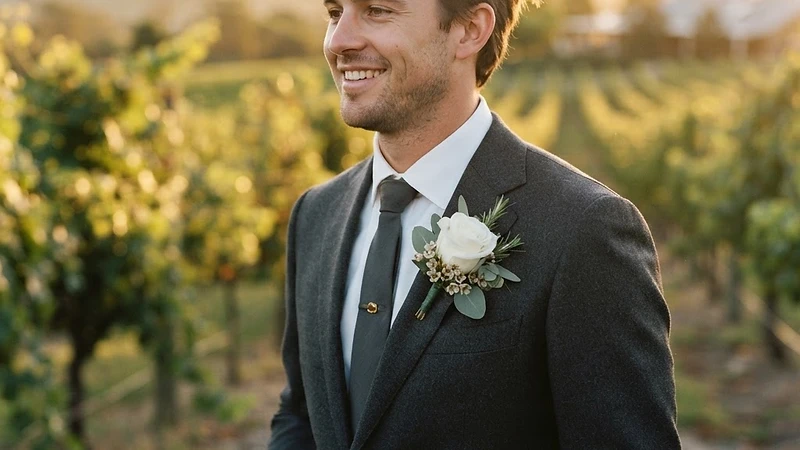
The five minutes nobody rehearses
Of all the moments I capture on a wedding morning — the nervous pacing, the cufflinks fumbled twice, the best man reading his speech under his breath for the hundredth time — there is one small ritual that trips up almost every groomsman I've ever photographed: pinning the boutonniere.
It happens in hotel rooms overlooking Newcastle Harbour. It happens in the weatherboard cottages scattered through Pokolbin. It happens, more than once, in the gravel car park of a Hunter Valley cellar door with ten minutes until the ceremony starts. Someone holds the flower upside down. Someone else jabs a pin through their own thumb. And inevitably, someone looks at me and asks, "Mate, can you do this?"
I'm there to document the day, not stage-manage it — but I've pinned enough boutonnieres between shutter clicks that I thought it was time to put the process down properly, with photographs, so your groomsmen can get it right without me having to put my camera down.
Why the boutonniere still matters
A boutonniere is a small thing with a long memory. It echoes a tradition that goes back further than most people realise — flowers worn into battle, into courtship, into the earliest wedding ceremonies — and if you want the full story on where that custom began, it's worth a read on its own in our wedding traditions archive.
But on the day itself, it matters for a much simpler reason: it's the first piece of styling your groom and his groomsmen put on together, and it's almost always the first thing I photograph once everyone's dressed. A well-pinned boutonniere stands vertical, hides its pin behind the lapel, and doesn't droop by ceremony time. A poorly pinned one ends up crooked in every photo from the vows to the vineyard group shot.
Before you pin: a few Hunter Valley realities
Florals in our region spend a lot of time in the heat. If you're getting ready at a vineyard property in January, keep the boutonnieres in their box, in the coolest room available, out of direct sun, until fifteen minutes before photos begin. I've seen beautiful native arrangements — kangaroo paw, waxflower, a bit of eucalyptus — wilt in a hot car boot on the drive from Pokolbin into the ceremony. Ask your florist to deliver as close to go-time as practical, and keep that esky or cool box handy.
Step-by-step: how to pin a boutonniere
The left lapel — and never the shirt
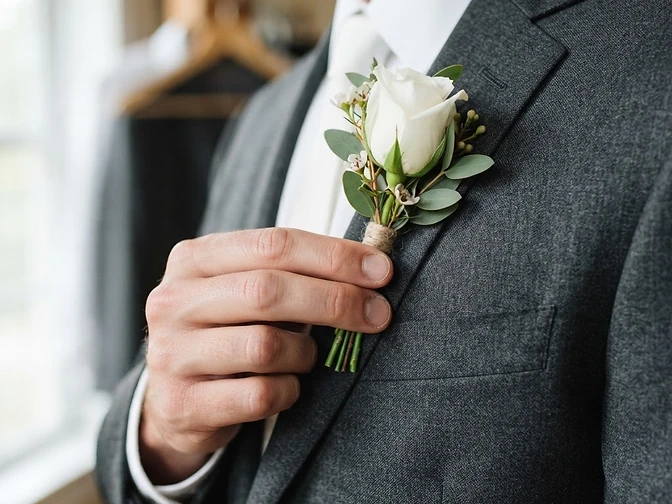
The boutonniere goes on the left lapel, over the heart, sitting vertically: flower head pointing up toward the shoulder, stem running straight down the face of the lapel. Hold it there first and just look at it from a metre away — that's the distance most of your portraits will be made from.
Get behind the lapel
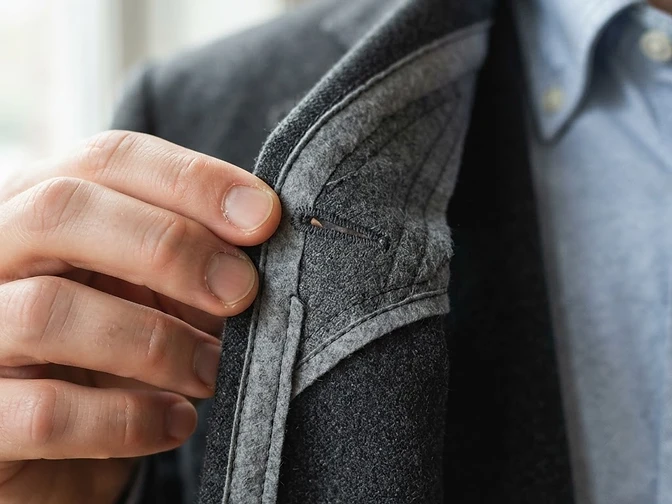
Here's the part almost everyone gets wrong: the pin goes in from the back of the lapel, never through the front. Fold the lapel back, or work from behind it, so you're looking at the underside of the fabric. Go in from this side and the sharp end never points at the front of the jacket, and nothing silver catches the light in a photograph all day.
Set the stem and hold it still
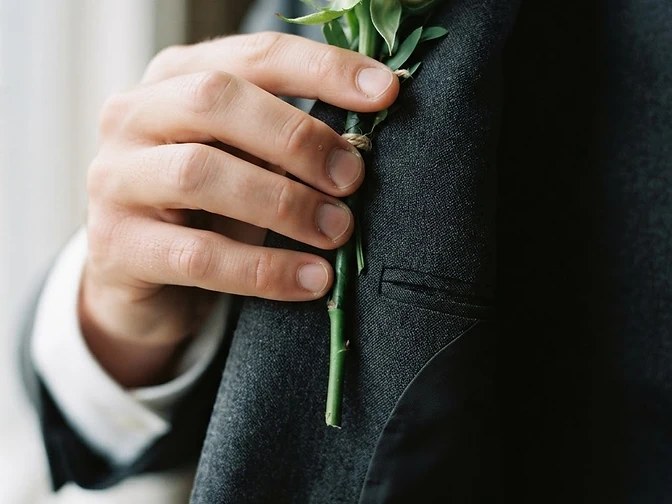
Position the flower so the head clears the top edge of the lapel and the stem runs down behind it, below the blooms. That stem is the part you pin, because it's the only part with any structure. Keep the whole arrangement vertically aligned rather than tilted. This is much easier with two sets of hands: one person holds the stem flat against the fabric, the other works the pin.
One pin, straight through the stem
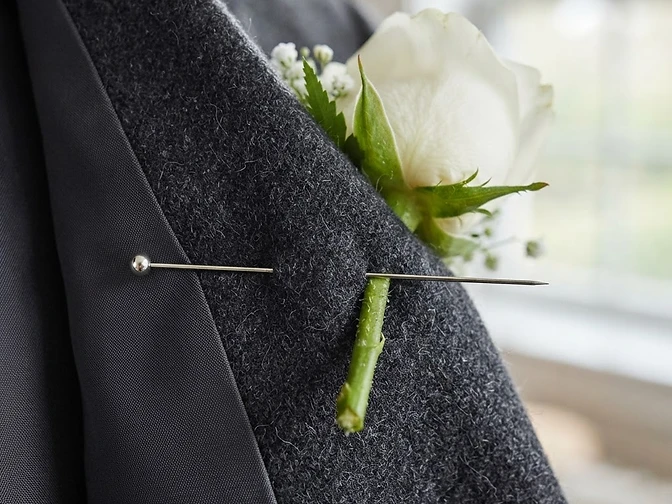
Most boutonnieres need exactly one pin. From behind the lapel, push it straight through the stem just below the flower heads and out through the lapel fabric. Straight, not on an angle: an angled pin gives the stem something to rotate around, and by the ceremony the flower is sitting sideways.
Heavier arrangements: two pins, crossed
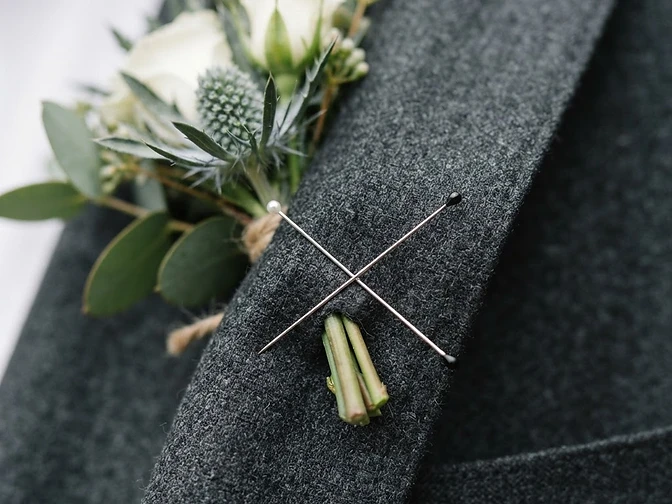
If your florist has built something with real weight — eucalyptus, thistle, a succulent, a big protea — one pin will pivot. Use two, crossed in a shallow X through the stem below the flowers. Two points of contact stop the arrangement turning and stop a heavy head tipping forward through the vows. On a thick or wired stem, a third pin does no harm at all.
The check: no pins, vertical, and the hug test
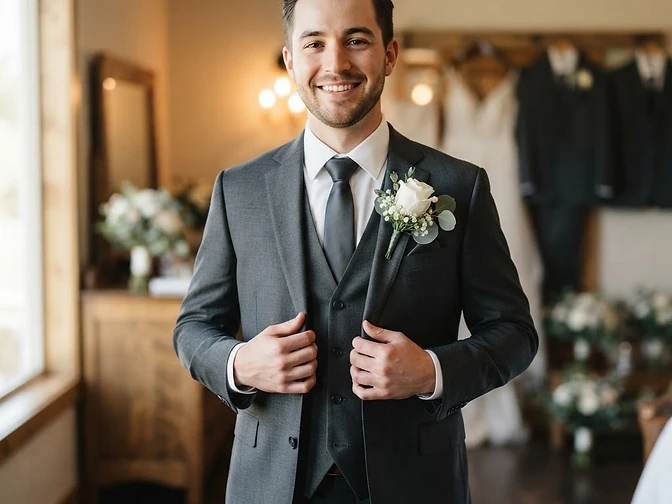
Stand back and confirm three things: no pin is visible from the front, the flower is standing vertical rather than leaning, and you can hug somebody without it shifting. That last one is the real test — the congratulations after the ceremony are where a loose boutonniere gives up. If it moves, add a second pin rather than moving the first, because a fresh hole beside a loose one only widens.
What about vests, suspenders, or no jacket?
More and more of my Hunter Valley grooms are skipping the jacket altogether for a vineyard ceremony in the warmer months, especially out around Pokolbin and Luskintyre where the afternoon sun doesn't mess about. If your groomsmen are in waistcoats, the same pinning method works beautifully on the lapel of the vest.
No jacket and no vest is the one genuinely awkward case, because there's no lapel to pin to. Pin the stem to the suspender strap rather than to the shirt — the strap has something solid behind it and the shirt has nothing. What you should never do is pin straight through the shirtfront: cotton has no weight to hold a flower, the pin pulls a hole through it within the hour, and it's the one mistake that can't be fixed on the morning. If there's no strap to work with, ask your florist for a magnetic fastener instead.
A simpler option for little ones
If you've got a page boy or a young ring bearer in the bridal party, consider asking your florist for a magnetic boutonniere fastener instead of a pin. It's a small detail, but it means no small fingers near sharp points — and one less thing for a nervous mum to worry about an hour before the ceremony.
A local note
I've pinned boutonnieres in the dressing rooms at Camp on Hunter more times than I can count, usually with the Hunter River glinting through the window and the groom asking me three times if it's crooked. It never is, once you've anchored it properly — and that extra thirty seconds buys you flowers that still look sharp in the photos from the first dance, long after the ceremony's finished.
Get this small ritual right, and it's one less thing to think about on a morning that's already full of them.